Managing the transition to the new U.S. $10 note
A comprehensive upgrade strategy for cash handling networks
Executive summary
The introduction of the redesigned U.S. $10 banknote marks the beginning of the most significant currency modernization program in decades. As the first denomination in the U.S. Treasury’s next-generation currency redesign schedule, the new $10 note is expected to enter circulation in 2026, with widespread operational impact extending throughout 2027 and beyond.
While consumers may view the redesign as a simple change to the appearance and security features of a banknote, businesses that rely on cash automation technologies face a far more complex challenge. Financial institutions, retailers, casinos, transit operators, cash-in-transit providers, and self-service operators must ensure thousands of cash handling devices can accurately identify, authenticate, count, dispense, store, and process both old and new note designs simultaneously.
The challenge extends beyond major banking networks. Large financial institutions often establish centralized upgrade strategies, yet many cash processing devices throughout branch networks are procured, maintained, and managed locally. This creates a fragmented landscape where hundreds—or even thousands—of devices may require upgrades, software updates, validation testing, training, and reporting.
Cennox is uniquely positioned to manage this transition through nationwide project management, field services, technical support, customer communications, and reporting capabilities that help organizations successfully navigate every phase of the currency upgrade cycle.
Understanding the new $10 note rollout
The Bureau of Engraving and Printing (BEP), the U.S. Treasury, the Federal Reserve, and the U.S. Secret Service have developed a phased currency redesign strategy to strengthen anti-counterfeiting measures and maintain confidence in U.S. currency.
The current redesign schedule includes:
| Denomination | Planned Introduction |
- $10 Note | 2026
- $50 Note | 2028
- $20 Note | 2030
- $5 Note | 2032
- $100 Note | 2034
Although issuance begins in 2026, businesses will experience the greatest operational impact throughout 2027 as circulation volumes increase and both existing and redesigned notes coexist in the marketplace.
Unlike many countries that replace old currency rapidly, the United States operates a gradual transition process. Older notes remain legal tender indefinitely, meaning businesses must prepare systems capable of processing multiple note generations simultaneously.
Federal reserve and treasury guidance for businesses
Federal agencies have consistently emphasized several key principles during previous currency redesign programs:
1. Early Preparation
Cash handlers should begin readiness planning well before public issuance. Equipment manufacturers, financial institutions, and cash processing organizations are encouraged to review compatibility requirements and testing schedules as soon as new specifications become available.
2. Machine Readiness
The BEP estimates that more than 10 million devices worldwide process U.S. currency. These include:
- ATMs
- Teller cash recyclers
- Cash deposit machines
- Self-checkout systems
- Vending machines
- Transit ticketing systems
- Casino gaming equipment
- Currency counters
- Banknote sorters
- Smart safes
- Retail cash management devices
Manufacturers receive sample notes and technical specifications to validate machine performance before widespread issuance.
3. Training and education
Federal agencies traditionally launch extensive education campaigns for:
- Bank tellers
- Retail cashiers
- Loss prevention teams
- Cash-in-transit providers
- Equipment technicians
- Back-office cash processors
Organizations are encouraged to train employees on new security features and note authentication procedures before notes enter circulation.
4. Dual-circulation readiness
Businesses must be prepared to handle both existing and redesigned notes for many years. This requires software, firmware, and operational processes capable of recognizing multiple note generations.
Why device readiness is more complicated than many organizations expect
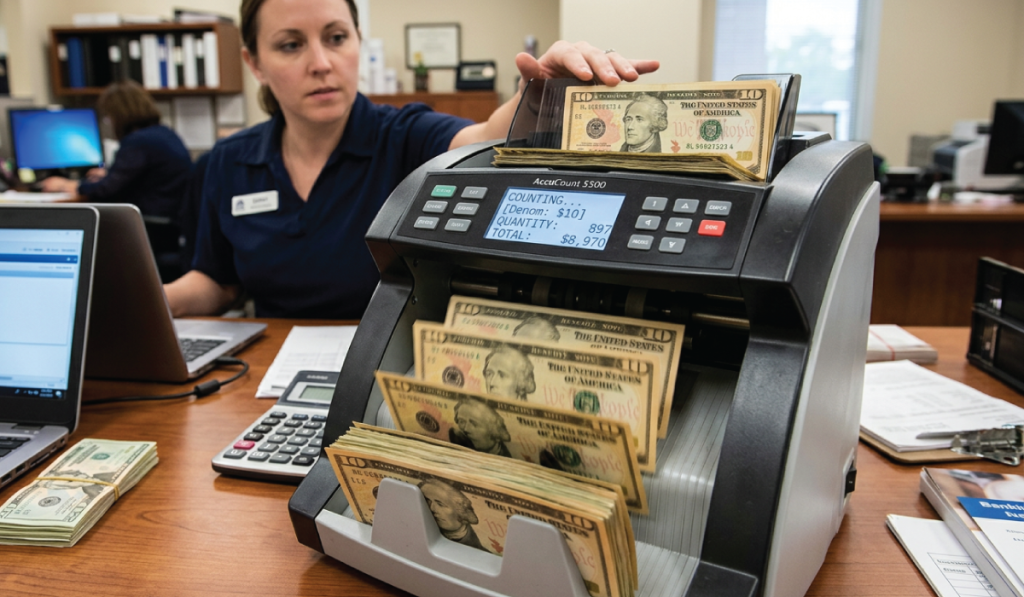
For many organizations, the challenge is not simply upgrading a handful of machines.
Large banking institutions often make strategic upgrade decisions at a corporate level, but the reality of device ownership and management can be far more decentralized.
A typical national banking network may contain:
- Branch cash recyclers
- Teller counters
- Coin and note processing equipment
- Drive-through systems
- ATM fleets
- Smart safes
- Third-party cash automation solutions
Many of these assets have been acquired over time through:
- Local procurement decisions
- Regional purchasing agreements
- Mergers and acquisitions
- Vendor-specific contracts
- Branch-led equipment refresh programs
As a result, headquarters may establish a currency readiness policy while hundreds of devices remain managed locally across individual branches.
This fragmented environment often creates challenges such as:
- Incomplete device inventories
- Unknown software versions
- Inconsistent maintenance records
- Multiple equipment manufacturers
- Varying service providers
- Limited visibility into upgrade status
Without centralized oversight, organizations may struggle to determine which devices require updates, which are compliant, and which locations remain at risk.
The expanding self-service landscape
The challenge becomes even more significant when considering today’s self-service ecosystem.
Many organizations now operate large fleets of:
- Interactive teller machines (ITMs)
- Self-service banking kiosks
- Cash deposit ATMs
- Retail self-checkout systems
- Automated payment kiosks
- Smart locker payment terminals
- Transit fare systems
- Gaming and casino devices
These systems often require elevated access credentials, specialist software, manufacturer certifications, and detailed testing procedures.
A simple software update may involve:
- Device assessment
- Vendor coordination
- Firmware validation
- Security approvals
- Deployment scheduling
- Operational testing
- User acceptance verification
- Reporting and compliance documentation
Managing this process across hundreds or thousands of devices can quickly become a major enterprise project.
How Cennox supports currency transition programs
Cennox provides organizations with a structured approach to currency readiness through a combination of project management, field services, technical support, and nationwide deployment capabilities.
Discovery and asset assessment
The first challenge in any upgrade program is understanding the current environment.
Cennox can help customers:
- Identify installed device populations
- Verify hardware configurations
- Confirm software versions
- Assess upgrade eligibility
- Prioritize high-risk locations
This creates a centralized view of the network and establishes a foundation for transition planning.
Reach-out services
Successful upgrade programs depend on effective stakeholder communication.
Cennox can coordinate:
- Branch outreach
- Site readiness assessments
- Scheduling coordination
- Vendor engagement
- Deployment communications
- Progress updates
This reduces administrative burden on customer teams while ensuring all stakeholders remain informed.
Reactive and proactive support
Not every device behaves as expected during a major currency transition.
Cennox supports both planned upgrades and reactive service responses through:
- Help desk coordination
- Field technician dispatch
- Escalation management
- Technical troubleshooting
- Device validation testing
This minimizes disruption while helping maintain service availability.
Nationwide deployment capability
With a nationwide field service footprint and dedicated project management teams, Cennox can coordinate large-scale upgrade programs across geographically dispersed locations.
Services include:
- Technician scheduling
- Multi-site deployments
- Installation management
- Validation testing
- Progress tracking
- Executive reporting
This provides customers with a single point of accountability throughout the transition process.
Managing risk through program visibility
One of the most common challenges during a currency redesign is the lack of visibility into deployment progress.
Cennox addresses this through structured reporting that enables organizations to monitor:
- Devices identified
- Devices assessed
- Upgrades scheduled
- Upgrades completed
- Open issues
- Escalations
- Compliance status
- Regional performance metrics
This allows leadership teams to understand readiness levels across their entire network and make informed decisions throughout the rollout.
Looking beyond the $10 note
While the redesigned $10 note represents the first major milestone, organizations should recognize that the broader U.S. currency modernization program extends through at least 2034.
The upcoming redesign schedule creates a recurring cycle of:
- Equipment validation
- Software updates
- Staff training
- Compliance testing
- Operational reporting
Organizations that establish a structured upgrade framework today will be better positioned to manage future denomination changes with less disruption and lower overall cost.
Conclusion
The redesigned U.S. $10 note is far more than a currency update. It represents the beginning of a decade-long modernization program that will affect millions of cash handling devices across banking, retail, gaming, transportation, and commercial sectors.
The complexity of these transitions often lies not in the technology itself, but in the fragmented ownership, management, and maintenance structures that exist across large device networks.
Through nationwide project management, field services, reach-out programs, reactive support, asset visibility, and detailed reporting, Cennox provides organizations with a scalable framework for managing currency readiness initiatives.
As businesses prepare for the widespread circulation of the new $10 note throughout 2027 and beyond, having a trusted partner capable of coordinating upgrades across diverse device environments will be critical to maintaining operational continuity, compliance, and customer confidence.
References
- U.S. Currency Education Program – $10 Note Information
- https://www.uscurrency.gov/denominations/10
- U.S. Currency Education Program – Frequently Asked Questions
- https://www.uscurrency.gov/about-us/frequently-asked-questions
- Bureau of Engraving and Printing – Currency Redesign Program
- https://www.bep.gov/currency/currency-redesign
- Federal Reserve Currency and Coin Services
- https://www.federalreserve.gov/paymentsystems/coin_currency_orders.htm
- U.S. Currency Education Program
- https://www.uscurrency.gov